Tuesday, July 10, 2018

The Last Day in Israel (This Time)

Sunday, July 9th was our final day in Israel. Our flight home would leave early the next day, and we were anxious to make the most of it. The family voted to return to Ayin Mevoah, the desert spring we had been to the previous week. This time my mother trekked down with us. We all had a lot of fun. The kids wanted to take a series of pictures that would make it look like they were throwing the water up into the swimming area. (The photos weren’t so convincing, lol.)


Refreshed as the day began, we headed back into Jerusalem detouring, to the (ahem) “delight” of our children, to the Mount Scopus campus of Hebrew University, where we had both been students (at different times). If we had had more time, perhaps we would have gone into the campus. David had a particular desire to get in to the campus synagogue, which has an amazing view, but we deferred to the temperament in the car and only took pictures from a tourist look out (and Yaakov chose not to get out of the car).


It was now time to return to Old City for one last visit to the Kotel (Western Wall). After parking in the underground garage of the Mamilla Mall, we were heading through the complex toward the Old City when I had the distinct pleasure of running into my friend Ammi Dorevitch... with whom we had visited at the very beginning of our journey when we spent Shabbas in Yad Binyamin. We had time for a quick hug and a final photo op and then the kids bustled me onward toward the Old City. This was our final opportunity to daven at the Kotel (this trip), and we all took advantage of it.


After that, however, we wanted to figure out a way to keep the rest of the gang happy and entertained. First we decided to return to Chezkiahu’s (Hezekiah) Wall, which had been covered with an inflatable moon on July 2. We figured that since the light show was over we might be able to see it, but the “moon” was still there. However, we did take advantage of heading out of the Old City via the air conditioned Cardo and ran into a very cool, somewhat life-sized, painting of how the streets of Jerusalem would have looked in the days of the Romans.


Asher snagged this flag from a store.
We went back to pay!
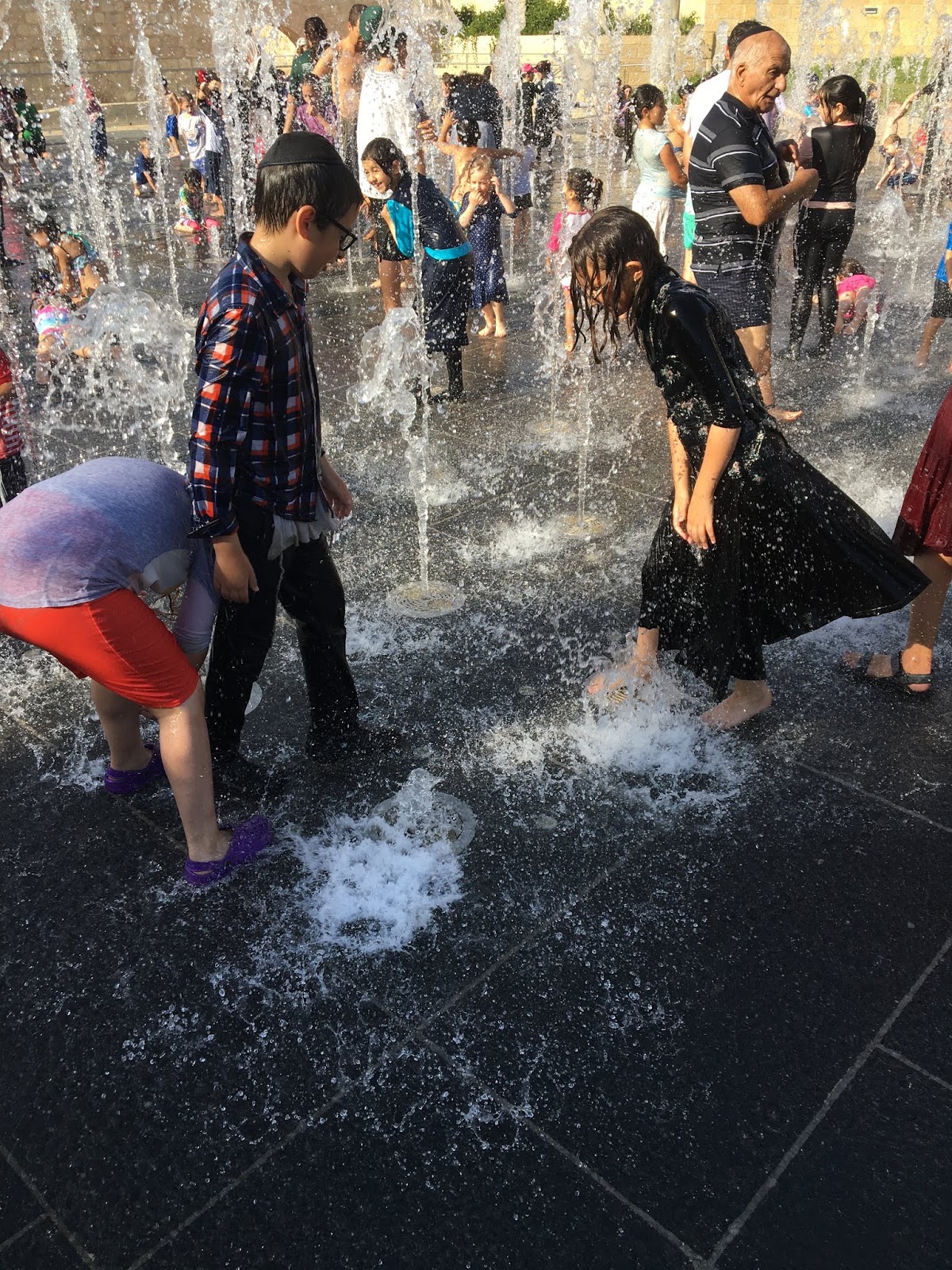
Tour book in hand, I decided that the Old Train Station sounded like a nice way to finish our “touristing” for the day. I was pretty certain, based on Waze GPS, that it was a fairly direct path of walking to there, through Teddy Park. I was wrong. We were hot. We were tired. And we were accidentally right next to an awesome water park. We couldn’t figure out why a crowd of people with kids in swimsuits were gathering around. Finally we were told that starting in five minutes the floor would come alive with spouts of water. The water literally danced from the floor. The kids went in fully dressed, and we didn’t care. Ok, Avi kinda hesitated about the fully dressed thing, and Asher was actually rather scared at first, but then the big kids “escorted” him.  It was the best accidental tourist incident ever!


The day had been full and exhausting (mostly due to the heat). We headed back to our van and returned to the apartment to finish packing and get ready for dinner. For our farewell to Jerusalem dinner we went to Café Rimon and then strolled around the Ben Yehuda Street area picking up a few last minute items.

Sunday morning we rose bright and early and headed back to Montreal (and my mom back to Harrisburg)


Hope you all enjoyed following our journey!

Friday, September 1, 2017

Teshuva and the Process of Humbling Oneself

“If My people, who are called by My name, humble themselves, pray, seek My face and turn from their wicked ways, then I will hear from heaven and will forgive their sin and heal them” (II Divrei Hayamim 7:14).

Most of us don’t get a chance to study Divrei Hayamim, and I only stumbled upon this quote when searching for new material for JewishTreats.org (my day job, so to speak). I never managed to find a way to use it in a Treat, but it stayed in my mind until I was ready to write my Elul group DT.
This quote is from the seventh perek of II Divrei Hayamim, which discusses the completion of the building of Solomon’s Temple. Hashem told Solomon that the people would stray and He would cause famine and pestilence against them. Verse 14 is the path to redemption, meant to take place in the Temple,  laid out by Hashem. Like so many verses in Tanaach, this posuk has meaning and significance beyond the context in which it is written. It offers the steps for the nation to redeem itself, and a beautiful path for individuals as well.

Quite often discussions at this time of year focus on the actions of teshuva: recognizing our transgressions, regretting them, confessing them, apologizing for them and actively seeking not to repeat them. I wonder, however, if this posuk in Divrei Hayamim is revealing that the action of teshuva, which is “turn from their wicked ways,” is actually the last step in a much more complex process.

Perhaps the teshuva process really begins with humbling one’s self. While one could say that is what is accomplished in recognizing one’s transgressions, I think that the process of humbling one’s self is more than just saying “I sinned.” Rather, it is recognizing our humanity, our inability to achieve perfection, and, therefore, our total dependence on Hashem.

The process of human humbling often, but not always, is a reaction to something happening to us: a business deal going awry, an injury, or, perhaps, drastic weather. This is when we turn to prayers from the heart that lead us to contemplate God and the world. Prayer is particularly on our minds during Elul and Tishrei. Even our prayers that we say everyday, without the incitement of being humbled, are transformed during the Aserres Y’mei Teshuva, when we have to slow down and remember the subtle changes in wording.

Prayer is our venue in which we speak to Hashem, but the truth is that many of us pray out of a sense of yira - reverential fear - the reaction to knowing how much greater Hashem is than we are, how much we have for which to be grateful to Him (an understanding that comes through humbling one’s self). In the pasuk from Divrei Hayamim, the final step that comes before the actions of teshuva is “seek my face.” This step is striving to act out of ahava - love - rather than yira.  To seek God’s face it to try to get closer to Him, an act of a loving relationship.

Once these steps have been achieve, only than can true, heartfelt teshuva happen because it is not then an act, it is not a hope, it is not a striving. When we can achieve ahavas Hashem, then our act of teshuva is transformational. And this idea leads me to another quote I found that same day which I tried to use as well (but didn’t):

“Rabbi Meir used to say, ‘Great is repentance for on account of one true penitent, the entire world is pardoned” (Talmud Yoma 86b).

I do try and do proper teshuva during Elul and Tishrei, and I can’t say I do a fabulous job because I honestly can’t remember the majority of transgressions that I am certain I have committed. So when I read this quote, I was trying to imagine the power of such a true penitent and I think that such a penitent would have to be one who had really and truly transformed their emunah and their relationship with Hashem.

For those of us who are still just working on humbling ourselves, on embracing emunah and, perhaps, learning to pray truly...Rabbi Meir’s statement can also be read differently. When an individual works hard at the actions of teshuva, just the final steps of turning from wicked ways, and succeeds, they have, indeed, managed to ensure that an entire world is pardoned: their world. As it says in Sanhedrin 37a: “Whosoever preserves a single soul..., scripture ascribes [merit] to him as though he had preserved a complete world.”

As much as we would love to be superheros (ok, I’d just like to get through a day without screaming at my kids), the fact is that our first and most necessary project is to work on ourselves. We as a nation have to power to change the world, and we, as individuals have the power to be world-changers by effecting, ourselves and the world around us.

The women in this group are definitely world-changers. I’ve been part of the Elul group since its beginning, and I have seen the beautiful growth of the women involved, some friends, some strangers, but all dear to me at this time of year. Without question, Caryn and Ruthie deserve special credit in that world changing department, because they have offered this opportunity and encouraged me even in the years that I thought I could not actually manage it. May we all continue to grow together in emunah, yiras Hashem and ahavas Hashem.

Sarah Rochel Hewitt
----
So, one of my earlier drafts began like this, and I just wanted to include it as well as a separate thought:

“Rabbi Meir used to say, ‘Great is repentance for on account of one true penitent, the entire world is pardoned” (Talmud Yoma 86b).

I feel like I should apologize right here and right now. Sorry guys, I don’t think I am gonna make the cut this year. Sheesh, I don’t think I’ve ever come close to making that cut. And for that, I am sorry. Well, perhaps sorry is the wrong term...And for that I have regret and, to be perfectly honest, a good bit of guilt. I am so far from where I need to be that I wonder, sometimes, if there is something wrong with me.

But questioning, seeking, searching, accepting and starting all over again seems to be a critical element in Jewish life. It’s not for no reason that we ask for tshuvot (responses) as we learn how to grow spiritually and work toward true teshuva.

This past summer, my almost Bat Mitzvah daughter gave me a joltingly beautiful understanding of this process of growing through asking questions. On Shavuot, she informed me that she and several of her friends had been talking about “stuff” and, basically, questioning how one could actually know if any of what they were being taught was true. I was alarmed, mildly, yet pleased, mildly, too, because I know this is a critical step in her owning her Judaism for herself. I suggested we start learning something together and we went off looking for the right book to learn. We spent a month looking for something that was neither pre-supposing of emunah (like Living Emunah, which tells you how to live a life of emunah, but not how to gain emunah) or to baal teshuva oriented or too mature for her. Then life got busy and our search was forgotten a bit.

When, later, asked her if she was upset that we hadn’t managed to follow through on this project and find a sefer, she said no because she had come to realize that the answer was too big for someone to answer in a book and that these questions were actually too big for herself to be able to simply judge and understand.

I was blown away by her response. If only my own battle for emunah could be so brilliantly resolved!

Thursday, December 29, 2016

The Drippings of My Menorah

Do you clean your menorah each night after the flames have finished burning? Goodness knows I don’t, and each night it gets a little trickier to light the menorah. There’s old wax stuck in the hole, even after you use a random household item to try and scrape it out, and the cheap Chanukah candles break when you push them in. Or if you’re using oil (in our house we have both), then the cups from the first few nights are always grimy and slippery from previous splashes. So in our house, where we light quite a few menorahs, by the time we get to the eighth night of Chanukah, we have a pile of broken candles that never made it, lumps of broken off wax drippings (many imprinted with fingerprints) and a few discarded, slimy wicks from the oil menorah. And if you have one of those candle menorahs where the shamash, the lighting candle, is elevated in the middle of the row, every time you try to place the shamash in its proper spot, you bump into the candle next to it, resulting in additional spillage!


The mess of the Chanukah candles may seem  like a silly issue to discuss, but just the other day I was thinking that this issue may serve as an interesting metaphor for Jewish growth. When a person first becomes excited about Judaism, it is like setting up the menorah. There is great anticipation about participating in the new mitzvot, and the first acts of Jewish observance that one does on one’s own can be  compared to the first night of Chanukah. The menorah is in pristine condition and the candles fit in easily (unless, of course, it wasn’t cleaned after last year).

Time passes, however, and for many people who have moved toward greater Jewish observance, living a more involved Jewish life often results in the loss of some of the original sparkle of being new. It gets harder. Unexpected obstacles arise: bosses who have “emergencies” just before Shabbat or relatives who don’t understand the implication of “kosher style.”

More challenging than the unexpected obstacles, however, are the slimy drippings of apathy and routine. Mitzvot that were once exciting start to feel like common acts. There is a constant struggle to grasp again the beautiful inspiration that so energized those original first steps.

The Talmud records a disagreement between two of the great academies of Talmudic study: the Academy of Shammai and the Academy of Hillel. The first believed that eight lights should be lit on the first night of Chanukah, and one less on each night that follows. Hillel’s students, on the other hand, said that on the first night one candle is lit, adding one each night until eight candles are lit on the last night (Talmud Shabbat 21b).

One explanation cited in the Talmud for their different opinions was that the Academy of Shammai was comparing the candles to the decreasing number of bulls brought on the holiday of Sukkot. The Academy of Hillel, on the other hand, was underscoring the idea that matters of sanctity should always be increased rather than decreased” (ibid.).

It was decided that the practice of Chanukah should be observed according to the opinion of the Academy of Hillel. Each night we increase the light until the eighth glorious night when all eight candles burn in its full glory.

Following the path of traditional Jewish life can have its challenges. But the greater the effort that we invest, the brighter the light that we shine. The mitzvah of Chanukah is intended to proclaim to the world our faith in God’s constant and active role in our lives. This is what we do when we tell that boss that we cannot work late on Friday or explain that the term kosher of “kosher rye” refers to a style and not that the bread is actually kosher.

Jewish life is a spiral of cycles. There are the daily cycles of prayer, the weekly cycles of Shabbat, and the yearly cycle of holidays. Each requires preparation. If I, as a working mother of five, don’t pick away at the “wax drippings” of chaos that dominate my home every morning, then I won’t have time for the daily morning prayers. If I don’t prevent “slippery spots” from entering my schedule, then I have to work harder to prepare for Shabbat, and if I don’t prepare in advance, then I cannot make the most of the beauty that inhabits each of the Jewish holidays.

If I were to continue my metaphor of the crowded menorah, then perhaps I would say that not only do I shine brighter the more effort I invest, but I would also connect to the shamash.  For everything that I do, my role is now that of being a continual helper. How I treat my own menorah -- my own spiritual development -- is reflected in the lights that surround me, the neshamot (souls) of my children.

This year, as the lights of Chanukah increase and we each stand by our menorahs trying to remove the drippings from the night before, think not of the struggle against the wax, but rather of the incredible brilliance and rays of  holiness of your beautiful Jewish soul.

Wednesday, September 14, 2016

Facing Manhood

This Dvar Torah was written as part of a group that says Tehillim/Psalms together during the month of Elul (through Yom Kippur).


5777 - This is the year my son will “become a man,” as popular Bar Mitzvah messages assert. In just over seven months, my bachor will become Bar Mitzvah and for the last several months this fact has become a constant little niggle, that type of thing one says one isn’t going to think about but nevertheless finds oneself constantly discussing. Halls for the kiddush, caterers, how to balance the different things he needs...

As I sat thinking about the Dvar Torah I wanted to write, the Bar Mitzvah once again popped into my head. This time, however, my thoughts were not focused on the “to do” but rather on the personal significance. Every year when I get “the call” (ok, the email, but it’s so much more dramatic sounding the other way) about the Elul group, I become suddenly more aware of the growth I need to do, of the growing I haven’t done... of my status as a baneinu. I’m not bad, but I’m not particularly good, either.

Twenty some odd years ago, I started keeping mitzvot. The first several years were all about acquiring knowledge and adding observance. They were hard because had to bend myself, but they were easy because there was so much new to do...and so much encouragement!

When I got married, I expected many things from myself, but life, work, children, running...running...running (B.H.) kept me very busy. Slowly, learning and growing drifted away. Even davening. Last year, I believe, I wrote about davening and how much I increased my davening as I expected my fifth child. One of the other reasons I made an active effort to increase my davening was that I wanted my children, my girls in particular, to see me daven, to know that it wasn’t just Tatty who did so.

This year, about two months ago, I found a whatsapp group of women in my neighborhood (mostly). The group is about emunah and growth but, to be honest, I really joined it to try and build a stronger social connection within Montreal. I found much more. I am in awe of the spiritual drive of these ladies, just as I am in awe of the dedication of the ladies of this Elul list -particularly, of course, Caryn and Ruthie, who have been doing this longer than a bar mizvah.  Last week this group spoke of the idea that a tzadik cannot stand in the same place as a Baal Teshuva, which led to a discussion of how doing teshuva provides each person witha chance to not only start anew, but to really start to be new. As the conversation got deeper, I was struck by the thought that I didn’t really deserve the title of Baal Teshuva anymore. Sure, became observant on my own, but last year I actually passed the mark of being shomer Shabbat longer than not being shomer Shabbat...and what growth had I been doing?

Today (ok, tomorrow) is first day of Elul. The King is in the Field! Now is the time, the best time, for me to seize the day and start myself anew. This Elul, I want to use the energy of the month to call out from my heart: “Hashem, help me grow! Hashem, open my soul! Hashem, help me feel that passion I felt when I first started this journey. And Hashem, help me show that love and passion for Torah to my children!”

The ladies with whom I have been learning are incredible, spiritual and connected on an emotional level. If you know me, you know that is not so much how I am wired. But I learn from them, as I learn from each woman on the Elul list each year, how to be a little more. And from each of these things I am inspired by the necessity to open up, to call out and communicate to Hashem in the same way I have a “heart to heart” with a good friend, and then more so.

Once upon a time, I used to seek out deep texts and challenge myself to create innovative and admirable divrei Torah. I wanted to do that again...So here is a very brief thought, and not that wow. I have been looking into Mishlei a bit, an excellent source of quotes on which to build Jewish Treats, and I was struck by several verses in Chapter 16:

16:3 Commit your works to the Lord, and your thoughts shall be established.
16:7 When a man's ways please the LORD, he makes even his enemies to be at peace with him.
16:9 A man's heart devises his way: but the Lord directs his steps.

If I have the right intention in any of my endeavors – I try to exercise knowing that I am acting on a mitzvah of taking care of my body, if I focus on cooking Shabbas not as a chore (yes, sorry, week after week) but for the mitzvah - then God will help me in those actions. And I believe this means, for me at least, that I will gain a level of serenity from doing them. This connects to the next verse quoted, but my biggest enemies are in my head. From the yetzer harah to low self esteem, I am easily brought into a negative headspace. When I have given my thoughts and actions a God-focused perspective, however, I find more peace. Last, but not least, of course is a verse that makes me think of “man plans, God laughs,” but it is not nearly so flippant. This is the essence of free will. I get to make decisions, but God is still maneuvering all the pieces on the board to either help or hinder my wishes from coming true.

I don’t know if that made sense to anyone, and in truth I am adding that paragraph just before sending it (when I should be cooking). Mostly now, I write to inspire only myself, and, if by chance you can relate to what I have set down, I hope I give you chizuk as well. I often find that reading of other people with similar thoughts, feelings, experiences can give me strength to grow and move forward.
In seven plus months, my son will have to take responsibility for his own mitzvot. During the hectic months to come, I hope to work on myself as well, so that when he becomes something more, I too can be something more and reclaim the legitimacy of the label B.T.

Thank you all for the inspiration.

Thursday, September 17, 2015

Elul Group - Davening Thoughts

This Dvar Torah was written as part of a group that says Tehillim/Psalms together during the month of Elul (through Yom Kippur).

First and foremost, a hearty yasher koach to Caryn and Ruthie for once again arranging this group.

While I must admit that I have not been able to read all of the divrei Torahs, the ones that I have read have been inspiring, moving and strengthening in that it helps to “hear” people touch upon so many concepts that I see in my own life. I would like to also apologize to the group for the days I missed saying tehillim. Hodu L’Hashem, we were blessed with a little boy on 21 Av (which was 6 August) so the first few weeks of Elul were kind of a blur.       

Our Rabbis have taught: On entering the barn to measure the newly harvested grain one shall recite the benediction, ‘May it be Your will O Lord, our God, that You may send blessing upon the work of our hands.’ Once he has begun to measure, he says, ‘Blessed be He who sends blessing into this heap.’ If, however, he first measured the grain and then recited the benediction, then his prayer is in vain, because blessing is not to be found in anything that has been already weighed or measured or numbered, but only in a thing hidden from sight” (Talmud Taanit 8b).

More succinctly put, as noted on the same Talmudic page, “In the school of Rabbi Ishmael it was taught: Blessing is only possible in things not under the direct control of the eye, as it is said, ‘The
Lord will command the blessing with you in your barns’” (Deuteronomy 28:8).

We are in the midst of the time of year when this message is particularly appropriate because we are all focussed on analyzing the year that has passed and contemplating what we want for the future. Living in a world where there is so much immediate gratification and so much technology that allows us to discover the unknowable,  we often approach situations with a desire, almost a need, to know the answers to all of our questions and all of the undetermined aspects of our life.

During the course of my pregnancy, I was in a position where my doctor was placing a lot of pressure on me to go for extra testing to make sure everything was as desired (given my age).

A natural worrier, this pressure caused a great deal of anxiety for me until I thought about this concept. Now was the time to step away from my need for control and to remember that HaShem runs the world. I told the doctor that I was going to go with the faith in God plan. Having refocused my brain on emunah (rather than worrying), it was time to transform that into action.
Davening, however, has never been easy for me. I have a hard time concentrating, prioritizing my time and most importantly, as anyone who knows me will agree, asking for something.

Once upon a time, I davened Shacharit and Mincha every day. The year I was in aveilus for my father, I even went to a mincha minyan most days. Baruch Hashem, life got busy, and I found myself missing mincha more often than not. Then life got busier still and my davening time was reduced to birchat hashacher...often mumbled while serving breakfast. Like many people, my davening increased in times of difficulty, but that often faded.

My davening actually began to increase a little over a year ago, not because I felt that I was connecting to Hashem, but because I thought it was important to set an example for my children. Now, however, I was davening for me.

I would love to say that my davening was transformative...the challenges I faced before are still there. When I go to daven, however, I try to remember that HaShem wants our requests and that He gives us a multitude of opportunities to turn to Him.

During the Aseres Ymai Teshuva, we change our davening - which is an excellent opportunity to work on concentration! - and I think that the alteration from haKel Hakadosh to HaMelech HaKadosh is a powerful reminder of our opportunity to make requests. HaKel is the idea of a deity, which is far less approachable than HaMelech, the King.

I am going to close now with a bracha that we should all only have simple things to daven for and that each of you should be blessed with bracha, parnassa, simcha and shalom.

(I apologize, I usually write more cohesively, but Asher seems to know every time I sit down to concentrate.) I will be giving tzedakah to Midreshet Rachel V'Chaya.

Sunday, September 6, 2015

Twenty Years Since Leaving Egypt

In our household, there is no holiday quite as beloved as Sukkot. One might find that funny since I hate being cold and I live in Montreal, Canada, where winter comes early and it has been known to snow on the holiday.

My husband, David, loves building his sukkah - and the personal possessive pronoun is the way he thinks of it. He even calculates how many invitations we get to other people’s sukkot over the holiday to make certain that we are home the majority of the time, preferably with guests.

When we first purchased our home, the attached courtyard/patio was a huge draw because of its ability to be transformed into a sukkah. There were, however, several issues to contend with before we could make a proper sukkah there. For instance, the existing walls are not quite tall enough. Luckily, my husband used to work in construction, and so, after consulting with our rabbi, he got to work making creative adjustments. Since then, once a year, he proudly gives friends a tour of the halachic (Jewish legal) concepts he used to “create a kosher” sukkah.

Our beautiful sukkah is not, however, the reason for my special feelings about the holiday of Sukkot. For me, there is a sentimental connection, particularly to Shabbat Chol Hamoed (Shabbat during the interim days of the holiday). Shabbat Chol Hamoed, you see, is the anniversary of my starting to observe Shabbat.

It all began just over twenty years ago when I spent my junior year of college at Hebrew University in Jerusalem. During that first month, when all the students moved about testing different friendships and cliques, I made arrangements with two friends to use the upcoming fall break, which began right after Yom Kippur, for a tour of Egypt. At the time, it didn’t occur to me that we would be traveling over the Sukkot holiday.

In the time between booking the trip and our departure I had become close with a group of students who were becoming observant - a path that I had also begun the year before. Even before I boarded the plane to Israel, I knew that I was going to become more traditional, but I did not expect to actually become Shabbat observant. With this new group of friends, I found the company of people striving toward the same goals and enjoyed beautiful Shabbat meals with local families. Additionally, the experience of celebrating the High Holidays in Jerusalem had a profound impact on my connection to traditional Judaism.

Coming off the high of a particularly inspirational Yom Kippur, I was suddenly faced with a true conundrum - whether to go on the very expensive trip for which I had already paid, or to celebrate Sukkot in Jerusalem. I went on the trip, but made my own “compromise.” I brought grape juice and cups and little cakes so that I could make kiddush (on the bus) in honor of the holiday. I also brought a prayerbook and made certain to recite at least one service each day.

I cannot deny that the tour of Egypt was  both fun and fascinating. Throughout the entire trip, however, I had this small, nagging feeling of discomfort even as I tried to be aware of whatever I could do to adhere to Jewish law.

Upon our return, as the bus began its ascent to Jerusalem, I felt an entirely new sense of anticipation. It was Friday afternoon, Chol Hamoed Sukkot. I had called ahead and knew that my friends had already arranged Shabbat meals for me. I kept glancing at my watch, worried that we might not make it to the city before sundown. Finally, we were there. Standing on the streets of Jerusalem, I experienced another inspirational moment as the first light rain of the season began. It was all-the-more amazing because Sukkot is the holiday during which we pray for rain in the Land of Israel. My friends and I grabbed a taxi, and I was back at the Mount Scopus campus with just enough time for me to drop off my stuff and change into Shabbat clothing. The rain stopped in time for everyone to enjoy the Friday night meal in their sukkot.

Twenty years later I can still remember the feelings I had disembarking from that bus in Jerusalem, the experience of that first rain, and, perhaps most significantly, the conscious choice to fully observe that Shabbat. In our daily prayers and during our holidays (especially Passover), the Jewish people spend a great deal of time remembering and being grateful for God taking us out of Egypt (yetziat Mitzrayim). In my mind, the return trip from Egypt was my own personal yetziat Mitzrayim.

When God took the Israelites out of Egypt, it was the beginning of their journey to the Promised Land. In fact, it was the beginning of a history of journeys. That first Shabbat in Jerusalem was the beginning of my own personal journey that has taken me to many places, both emotionally and physically, and has now led me to Montreal.

This Sukkot, I will sit in our beautiful, unique sukkah with my handy husband (who will probably have helped build one or two other sukkot in the neighborhood) and our incredible children and thank God for the wonderful blessings He has rained down upon me. On Shabbat Chol Hamoed (provided there is no snow), I will retell this story to my family while we huddle together under the heat lamp that my husband so thoughtfully installs for me each year.

Wednesday, October 1, 2014

Conscientious Connecting

This Dvar Torah was written as part of a group that says Tehillim/Psalms together during the month of Elul (through Yom Kippur).

It is almost Yom Kippur, and I am worried. I would love to say that I am sensing the awe of the season and experiencing the trepidation of these days so beautifully described in the sefarim (Jewish books) - but my worry is that I am not. (To be honest, this same difficulty occurs to me annually.) I worry because I can’t remember what I did last week that might have hurt someone, let alone six months ago. I worry because so many of my transgressions are the one’s that are considerably awkward to apologize for - a nasty response, impatience, a thoughtless comment, being a bad role model, a judgement made in jealousy, and etc. I worry that I did no spiritual work in Elul. (I didn’t even have time to read the emails of this group until Rosh Hashana!)

On the morning of Shabbas Shuva, the Shabbas after Rosh Hashana, after I miraculously davened all of Shacharit and Mussaf (with no interruptions!), I was granted an insight into myself that I did not wish to have: I have been stuck. I’ve been standing still. I’ve used a thousand reasons to let my spiritual growth plateau - kids, full time job, travelling husband - but these were all excuses for myself.

As I thought about the time of year we are in, I decided to make this Dvar Torah personal rather than "scholarly" and write about the hardest words (according to the Ziz in the children’s book): "I’m sorry."

We have among our children, one child who has had an issue with anger management. For a few months, life was a series of ceaseless, somewhat violent, tantrum. They were triggered by random issues - such as the cruel act of serving chicken for dinner. At one point, after being particularly aggressive, the child sullenly blurted out, "I’m sorry." Very honestly, I replied, "No you are not. Don’t tell me you are sorry unless you mean it."

These were words I would live to regret. The child understood me perfectly, but, a few days later, after yet another meltdown, when I said that an apology was appropriate, I was told "No." The child then declared that I myself had said that I didn’t want apologies. The first few times the child said this (in different instances), it was said in anger. Each time I explained to the child that I had meant that apologies had to have at least some level of sincerity to them. Then I noticed that the anger had changed to sadness and longing. Over time, the child had begun to feel trapped in their own refusal. This child wanted desperately to apologize and didn’t know how to back down from the refusal to dos so. (Baruch Hashem, we’ve worked through this.)

As I sat on Shabbas Shuva thinking about the Dvar Torah I wanted to write, my mind kept coming back to this situation and how appropriate it is for this time of year. When I read essays on Teshuva (repentance), I am reminded all about the necessary steps (recognize, confess, regret and not repeat), and I always falter when I think of the commitment not to repeat the act. If I had stolen something, I believe I could honestly say I would never do it again, but so many of my transgressions are the results of thoughtlessness. (Let’s take an easy one - nail-biting on Shabbas, which I do completely without realizing I am doing it.)

Suddenly, from my parental experience, I have a new insight. I never expected this child to offer me a fully, clear and sincere apology and a promise not to have another tantrum or to never hit a sibling again. What I did expect was a conscientious apology, an apology that recognized that something wrong had been done and that there was something for which to be sorry. Similarly, this is why the first step of teshuva is basic recognition. Even if I can’t guarantee I won’t repeat a wrong action, if I never recognize that it was wrong I will never move forward.

As I mentioned, I’ve been at a bit of standing still in my spiritual growth. Oddly enough, writing about Judaism on a daily basis for JewishTreats.org makes it harder to always be charged to learn. On the other hand, like so many others, my davening increased immensely this past summer (which means I actually davened more than once a month) due to the situation in Israel. I tried to carry this momentum into Elul, but by the second half of the month I would find the sun setting and I still hadn’t found my siddur.

The last few days, however, I have been making a true effort. I want to connect. I yearn to connect, and yet it is so hard. Even when I have the siddur before me, I am often only saying words rather than having a conversation. I think that this happens to a lot of people and this often makes it harder for us to follow through on daily davening when we have so many other commitments pressing upon us.

Here too, however, it is about conscientious efforts. After a tantrum, the child mentioned above, would often just stand in the room I was in, wanting comfort but not knowing how to undo the damage. Little did this child know that just showing me a pleasant countenance was healing the wounds of our balance.

Last week, heading into Rosh Hashana, I was cooking with my eldest. He was making the salmon for Rosh Hashana. I told him about the first time I ever made salmon and the person who guided me through (for those who don’t know me or don’t recall - I do not eat fish, I think it is gross, but I prepare it for my family). On the spur of the moment, we decided I should call this person and ask her if she remembered the recipe. This friend and I haven’t spoken in several years as I am lousy at keeping in touch. When we spoke, when I heard her voice, I felt instantly connected right back to her as I had been years ago.

I share this because this is made me think about davening. When I do make the connection to the Divine, it’s a warm, wonderful and familiar feeling. If I don’t take the steps to get there, trying to daven, trying to do teshuva, trying to grow spiritually, I will forever be missing the connection.

Last night, after most of this Dvar Torah had been composed, I went to a class and the first verse that was quoted by the speaker was: "Seek out Hashem while He may be found, call upon Him while He is near" (Isaiah 55:6), and I thought, the more we call upon Him now, while He is near, the more we can carry that connection through the rest of the year.