Tuesday, July 10, 2018

A Safe Journey to Some Special Sites

Today was our last day scheduled with Gershon, and I was determined that we would not start late, as we had most other mornings. We were out the door on time, but...there was a car blocking our van and it took nearly twenty minutes to resolve the situation. Why do I remember being late? Because the long wait for the man to get his keys compounded with needing a pit stop for Yaakov to deal with Yaakov being carsick made us late for our very tightly scheduled stop at Eretz Bereishith (The Land of Genesis). I felt bad because Gershon had negotiated with the guy there to get us an early slot to ride the camels, and we missed it.

Resigned to our fate we headed to the next spot, which was actually a surprise for us that was not far past Eretz Bereishith. We were heading into the Judean desert, and as we continued further south, the temperature was steadily rising. The signs indicated we were heading toward the Dead Sea and then, suddenly, Gershon instructed David to pull over to the side of the road, which was actually a small parking lot. From where we sat there appeared to be nothing particularly to do over here. Gershon assured us that this was going to be worth it and told everyone to get into their swim gear. Noticing that we were surrounded by tall mountains and steep valleys and that Gershon was pointing to a narrow, rocky path , my mother opted to stay in the car, perhaps fearful of another surprise hike.

The path to our destination only started off narrow and rocky. Shortly after, it became a paved road angled sharply downward. Gershon was 100% correct on how great this would be, as this proved to be our most popular recreational stop. At the bottom of the hill was a spring called Ayin Mavoah. The water of the spring was harnessed into a prepared swimming area deeply set into the ground. The unique feature of Ayin Mavoah was that it was a spring situated over underground caverns that worked as vacuums, sucking the water inward and pushing it outward again. In this way, the swimming hole emptied and filled with refreshing but very cold water every 20 minutes or so. It was very cool to swim in the deep water and slowly discover that one’s feet could now touch the ground until one was standing on dry earth, and then, after waiting a torturous few minutes, watching the water rush back in and feel oneself slowly float up. It was delightful in the heat, and it grew steadily more crowed as the morning wore on.


After the swim, we trekked up the long steep road and reunited with Grandma, who had waited patiently for us. Gershon proposed that we stop at Eretz Bereishith, which was on our way to our next stop, and try our luck at there being an opportunity to ride the camels. We were successful! Now, if we had made it at our scheduled time we would have ridden the camels down the descending path to a re-enactment area where one is meant to feel as if they are visiting the tent of Abraham and then, after prepared activities, return along a narrow trail once again on camelback. Because we were slipping-in between appointments and several more camels were needed below, we received a one way trip (and not a few of us were QUITE ok with walking back up anyway!).

The camels were sitting beside the building ready for “boarding.” Mom immediately opted for skipping the ride atop the tall dromedary and when David tried to bring Asher with him, the little guy flipped out. “No camel me!” he yelled, and so he stayed with Grandma. I paired with Yaakov, and we both firmly believe that the saddle was just slightly off-center. I felt like I was tilting sideways the whole ride to stay balanced.  Riding camels is a must-do for touring Israel, and I think we all fulfilled that requirement without a passion to do so again.


Out next stop was Kever Rochel, the Tomb of Rachel, which is located in Bethlehem. The Tomb is an isolated compound in the territory of the Palestinian Authority.

I have to be honest and note that I, personally, do not even remember how we got to Bethlehem. Many of the nights of the trip I had been up late working and the car lulled me to sleep. One moment we were in a familiar neighborhood in Jerusalem near the Old City and the next, what felt to me like a five second doze, we were in a similar neighborhood in Bethlehem. It was considerably disorientating.

Once upon a time, even when I came as a child, people who came to Kever Rochel saw this:


Alas, since the intifada and the transfer of Bethlehem to control of the Palestinian Authority, that humbly beautiful vision is lost behind massive walls topped with barbed wire and watchtowers. The parking lot was full as Jews come here in a steady stream to pray.

According to Jewish tradition, God was particularly open to the prayers of Rachel. In the merit of her having given her sister the secret codes that allowed her to marry Jacob (Genesis 29). For this reason, and perhaps because it has truly one of the longest histories as a Jewish holy site, it is considered a place where one has a more open, so to speak, line to God. Also, this site is very significant to mothers and to women who wish to be mothers because Rachel suffered to have children.


There isn't much to describe about being at the synagogue itself. We all did our own prayers and then met outside. Timing wise, a Mincha (afternoon service) minyan was about. To start. Since the girls and I had davened Mincha already, we waited outside with Yaakov and Asher. It was hot and one child became increasingly grumpy. When the guys came out and Gershon announced that we had a really cool opportunity to meet and see the small settlement attached to the Kever Rochel enclave, this child and I went back to the van for an emotional cool down. I hope I can get someone to write about it.



We grabbed a lunch of pizza and falafel in Gush Etzion and headed for Hebron and Maarat Hamachpela, the Cave of the Patriarchs, and truly one of the holiest sites in Jewish tradition.

I don’t know what I expected of the area we drove through between Bethlehem and Hebron, but the drive was not that much different than between any other towns we moved through in Israel.
Hebron is a town known for having a “challenging situation” between Jews and Arabs. The primary Jewish settlement, which is Kiryat Arba. Gershon had many friends an connections in the area, this being a particularly important location for people involved in active settlement, and he would have been delighted to give us a proper tour, but our goal in coming to Hebron was the “Tomb of the Patriarchs.”

This is the site which, according to Jewish tradition, Abraham purchased to bury Sarah because he knew that it was the cave in which Adam and Eve were buried. Abraham was also buried there, as were Isaac and Rebecca and Jacob and Leah (and, according to legend, the head of Esau, but that’s a whole story unto itself).  The incredible building that was built over this site was erected by Herod during the Roman era and has remained in use throughout the different rulers of the land. It has served as a synagogue, a church, a mosque.

Here’s a concise explanation for JewishVirtualLibrary.org:

This uniquely impressive building is the only one that stands intact and still fulfills its original function after thousands of years. Foreign conquerors and invaders used the site for their own purposes, depending on their religious orientation: the Byzantines and Crusaders transformed it into a church and the Muslims rendered it a mosque. About 700 years ago, the Muslim Mamelukes conquered Hebron, declared the structure a mosque and forbade entry to Jews, who were not allowed past the seventh step on a staircase outside the building.

Upon the liberation of Hebron in 1967, the Chief Rabbi of the Israel Defense Forces, the late Major-General Rabbi Shlomo Goren, was the first Jew to enter the Cave of Machpelah. Since then, Jews have been struggling to regain their prayer rights at the site, still run by the Muslim Waqf (Religious Trust) that took control during the Arab conquest. Many restrictions are imposed on Jewish prayers and customs at the Tomb of the Patriarchs despite the site's significance, primacy and sanctity in Jewish heritage and history.


I had been to Maarat Hamachpelah before, but it had been many, many years ago. I was very excited to have this opportunity to come here again. As we entered, we passed a family that was all dressed up. They were there to celebrate a bris milah, a circumcision.

Even before we entered, we were touring. I was fascinated by the place Gershon showed us that was the “seventh step.” As mentioned in the description above, when the Muslim’s had complete control of the site, Jews were not allowed past the outside staircase’s seventh step and many Jews still pray in that same location.

Maarat Hamachpela is divided into different chapels, for lack of a better English word, that are marked as the tombs of the Patriarchs. And while they appear to have large burial caskets within the alcoves, the actual remains of the patriarchs and matriarchs would be far below. Of course, having two boys with patriarchal names, I couldn’t resist taking pictures of them at their respective chapels.


The tomb of the Matriarch Leah, not sure why I don't have Leah's photo here like I had the boys.

More seriously, this is one of the most ancient sites in the heritage of our people. I definitely felt a profound sense of awe here and I made it a specific point to use my time there to daven (pray) for the people in my life and people I new had specific needs such as health, children, finding a spouse and parnassa.


As we left the complex, we stopped to take pictures with some lovely soldiers...


I think that everyone in our party gained something positive from this stop. However, the children were getting restless. At Gershon’s recommendation we returned to Gush Etzion and went to a park that was across from where we had eaten lunch. The park, which was dedicated to the memory of the three youths who had been kidnapped and murdered in 2014, contained several play areas appropriate for different ages, including a zip line. There was also an area for camping. Oddly enough, there was also a donkey wandering around...still not sure why.

Rebbe Tour!

It had been our intention to go to Masada and the Dead Sea today, but a good friend David’s made arrangements for us to be taken on what I jokingly call a “Rebbe Tour” of Bnei Brak this evening, so we revised our plans. Bnei Brak is part of the greater Tel Aviv city, so we tried to plan an activity on the way.

However, since we still wanted to get to Masada, and our only day to do so really seemed to be Friday, we knew that we had to use the morning to get ready for our second Shabbat in Jerusalem. Off to the Shuk we went once again. This time we attempted to drive... and it was almost as confusing as when we tried to walk. Wow! The fact is that some of the movements that we witnessed could be on a crazy driving series...and David maybe did an illegal move or two himself.

Our shopping today was a bit for Shabbas but also for gifts for home. The shuk was, as always, an active and vibrant experience. When we headed back to the Ben Yehuda/Geula area hoping to pick up the pre-ordered yad (silver stick with a hand pointing at the end, used for reading Torah). It wasn’t ready, but we did find a kiddush cup for Shevi.


We were told to meet our contact in Bnei Brak around 5, so our intention was to leave around 1:30 and find an activity to do on the way. I had some great suggestions, but we left late and traffic was horrendous, and we ended up going straight to our meeting (and getting there in the nick of time).

The best way to describe my first impression of Bnei Brak was...this place was never meant for people to have cars. The parking lots were practically part of the street. It was even crazier than Sfat! I was so glad David was driving and not me!

The feel of this evening in Bnei Brak will be very hard for me to convey. The people we were being taken to meet have dedicated their lives to studying Torah and uplifting the Jewish people. While I may not 100% understand their world (which adheres to a stricter understanding of Jewish law than my own community), I am in awe of their dedication.

I could describe each visit that we had, but the truth is that they are hard to capture in words. These various rabbis welcomed us into their homes, took time out of their schedules to spend a few minutes talking to us and they all showed a genuine interest in who we are. They shared with us their thoughts about varying subjects, from education in Bnei Brak to guiding advice for life. Some of the rabbis we visited were Rabbi Baruch Dov Poverski, Rav Dov Landau, Rabbi Eliezer Kahaneman, Rav Moshe Halevi and his son, Rav Shmuel Halevi, and Rabbi Moshe Hillel Hirsch. The most well-known of the rabbis that we visited was Rabbi Chaim Kanievsky, one of the gadol hador (leaders of the generation). We also visited his daughter, Rabbanit Leah Kolodetski, who, like her mother before her, opens her home to people and shares with them the joy of fulfilling the mitzvah of taking challah (the ritualistic part of making challah for Shabbat). She was warm and welcoming and gave out candy and sfarim (religious books).

As evening faded into night and we finished our visits, our guides/translators led us to what they considered the best place to get cholent in Bneu Brak (Indeed, the family loved it.) Before we left the city, we were handed an incredible smelling box of freshly baked challah made from the dough we took challah from with Rabbanit Kolodetski. The special challah, eaten that Shabbas, was AMAZING!!

The pictures below are all taken from a beautiful photo album of our Bene Brak tour that we received as a gift:

With Rabbi Chaim Kanievsy

At the home of Rabbi Eliezer Kahaneman

At the home Rabbi  Moshe Hillel Hirsch

At the home of Rebbitzen Kolodetski


Up The Great Mountain, A Day of Rest, A Night of Food

We had one thing on our agenda for our last Friday in Israel...the classic trip to Masada (Click here to learn what Masada is and why so many tourists go there).

This is from David's playing with the panoramic feature.
We rose early and headed south to the Judean Desert. We were delighted to find an indoor parking lot, meaning that our car wouldn’t get crazy hot. While tickets were being purchased, we looked at the scale size model of the mountain and some interesting artwork that was being sold as well. Then we made one of those silly tourist errors and got yelled at for leaving our backpack (filled with water bottles) on the bench. Yup, that’s ours, sorry!


We joined the line for the cable cars, which fit close to twenty people, for the ride to the top of the mountain. In our youth, both David and I had climbed up it, and back down, but we knew we couldn’t do that with the kids or my mom...and they actually closed the path due to heat that day!


We got to the top and found ourselves surrounded by different tour groups. Here and there we piggy-backed upon them, listening briefly to what the tour guide was saying, but we mostly went in the other direction first. (Ok, that was also because the kids needed the bathroom, which was toward the southern area, away from the main fortress area.)

As hot as the day was, we were quite comfortable (perhaps even a touch chilly) when we were on the mountain due to the brisk winds. It made it much more feasible how a group of men, women and children could survive living in the desert conditions. It was particularly windy in the building that once held the mikveh (ritual bath). We then walked the perimeter and spent some time in the covered shade over what was the synagogue. As the main excavations, the fortress on the north head of the mountain, were particularly crowded, we did them very superficially before recognizing that it was best to head back to Jerusalem.


After returning home, we had one more mission to accomplish before Shabbat. We wished to share some of the wonderful, holy challah from Bnei Brak with friends of ours who were visiting their daughter in the Nachlaot neighborhood of Jerusalem. Nachlaot and Rechavia are side by side, but it was an adventure in itself to follow the GPS directions through the windy streets.

...Shabbat

Our final Shabbat in Israel was much like the previous one, although we felt much more put together having done this once before. We also had a mix of food from Bnei Brak and our favorite French take out place around the corner.

As had occurred the previous week, David, Avi and Elisheva went to the Kotel (Western Wall) for services. They were back surprisingly quickly. Before we began lunch, however, everyone humored me to wait. I walked up the hill to the building I had noticed as being the home to Mayanot. I went in and found the rabbi, Rabbi Shleimy Gestetner. I asked to speak with him and told him that I knew he wouldn’t remember me, but that he and I had known each other when I was at Hebrew University in 1996-97.  He appeared to remember me, but I’m not so sure. I asked after his brother-in-law and sister-in-law, with whom I had been very close (and whom I have since contacted) and after the third member of the group I had known, James Oppenheimer, who, it now turned out, was running a popular restaurant near the Shuk. His place, called Crave, was supposedly a real hot spot, and so, when I told David about it, we decided to go as a post-Shabbat date.

It was a beautiful and relaxing Shabbat.

Our Saturday Night Date started out with the strange experience of entering the Machane Yehuda Shuk when it was closed up and quiet. Slowly, however, as we moved through its tunnel like alleys, different alcoves opened up and began spreading themselves across the lane, creating instant bars and restaurants. We were having trouble finding this supposedly popular eatery, and David suggested a few times that we just pick a place, but I was goal oriented. We finally pulled out Waze, and did a few circles to orient ourselves and then found our way to Crave, which was perhaps technically part of the Shuk, but I would say was more just beyond the Shuk. It was a weird, crowded, and very “happening” restaurant. We found a spot near the door and ordered a fancy Nacho platter to share as we weren’t that hungry. The food is billed as “Upscale Street Food,” and it was very good. I finally found James and reintroduced myself. He said he remembered me, but, again, it was nearly 20 years ago :).


The Last Day in Israel (This Time)

Sunday, July 9th was our final day in Israel. Our flight home would leave early the next day, and we were anxious to make the most of it. The family voted to return to Ayin Mevoah, the desert spring we had been to the previous week. This time my mother trekked down with us. We all had a lot of fun. The kids wanted to take a series of pictures that would make it look like they were throwing the water up into the swimming area. (The photos weren’t so convincing, lol.)


Refreshed as the day began, we headed back into Jerusalem detouring, to the (ahem) “delight” of our children, to the Mount Scopus campus of Hebrew University, where we had both been students (at different times). If we had had more time, perhaps we would have gone into the campus. David had a particular desire to get in to the campus synagogue, which has an amazing view, but we deferred to the temperament in the car and only took pictures from a tourist look out (and Yaakov chose not to get out of the car).


It was now time to return to Old City for one last visit to the Kotel (Western Wall). After parking in the underground garage of the Mamilla Mall, we were heading through the complex toward the Old City when I had the distinct pleasure of running into my friend Ammi Dorevitch... with whom we had visited at the very beginning of our journey when we spent Shabbas in Yad Binyamin. We had time for a quick hug and a final photo op and then the kids bustled me onward toward the Old City. This was our final opportunity to daven at the Kotel (this trip), and we all took advantage of it.


After that, however, we wanted to figure out a way to keep the rest of the gang happy and entertained. First we decided to return to Chezkiahu’s (Hezekiah) Wall, which had been covered with an inflatable moon on July 2. We figured that since the light show was over we might be able to see it, but the “moon” was still there. However, we did take advantage of heading out of the Old City via the air conditioned Cardo and ran into a very cool, somewhat life-sized, painting of how the streets of Jerusalem would have looked in the days of the Romans.


Asher snagged this flag from a store.
We went back to pay!
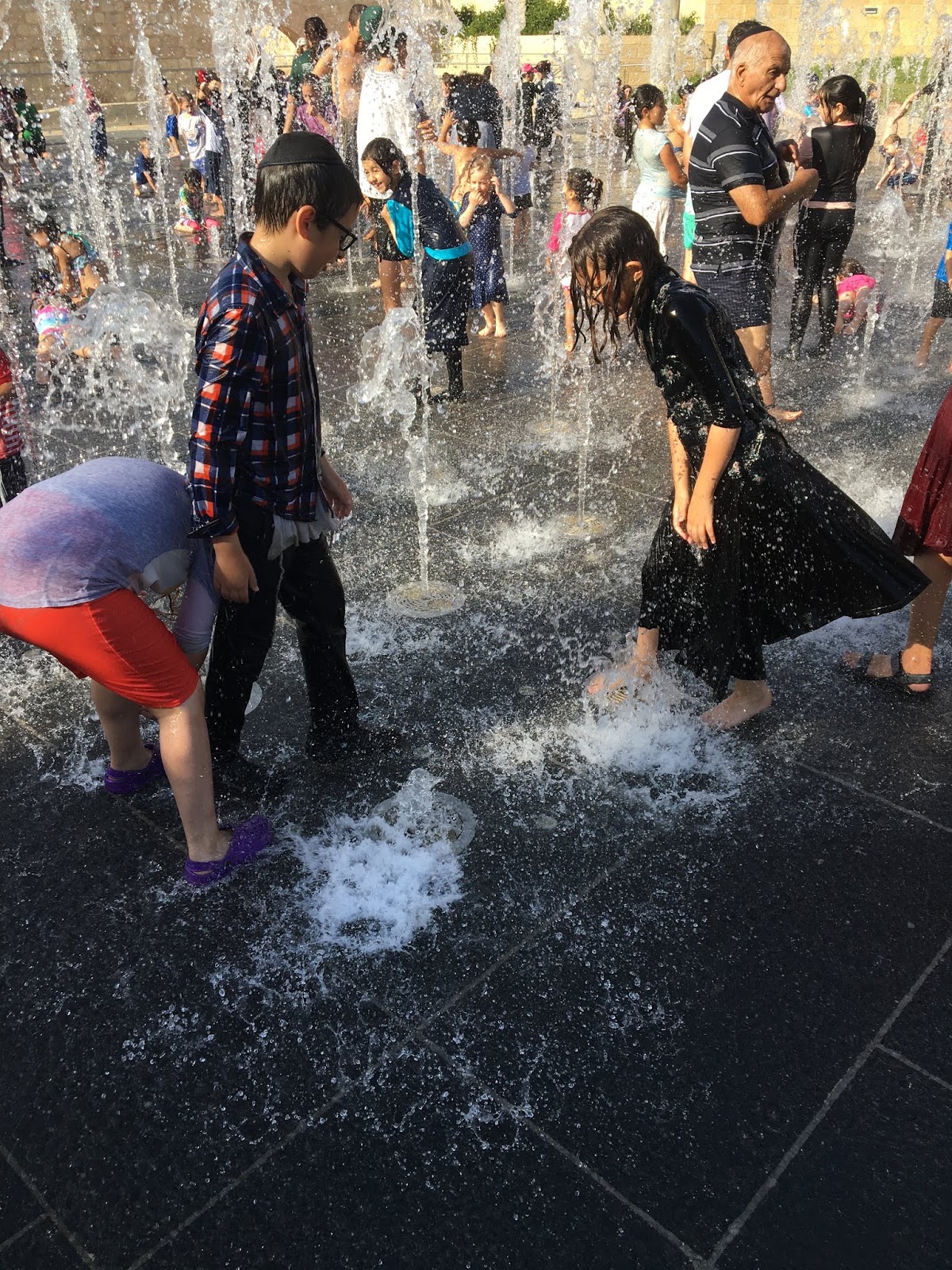
Tour book in hand, I decided that the Old Train Station sounded like a nice way to finish our “touristing” for the day. I was pretty certain, based on Waze GPS, that it was a fairly direct path of walking to there, through Teddy Park. I was wrong. We were hot. We were tired. And we were accidentally right next to an awesome water park. We couldn’t figure out why a crowd of people with kids in swimsuits were gathering around. Finally we were told that starting in five minutes the floor would come alive with spouts of water. The water literally danced from the floor. The kids went in fully dressed, and we didn’t care. Ok, Avi kinda hesitated about the fully dressed thing, and Asher was actually rather scared at first, but then the big kids “escorted” him.  It was the best accidental tourist incident ever!


The day had been full and exhausting (mostly due to the heat). We headed back to our van and returned to the apartment to finish packing and get ready for dinner. For our farewell to Jerusalem dinner we went to Café Rimon and then strolled around the Ben Yehuda Street area picking up a few last minute items.

Sunday morning we rose bright and early and headed back to Montreal (and my mom back to Harrisburg)


Hope you all enjoyed following our journey!