Tuesday, July 10, 2018

A Safe Journey to Some Special Sites

Today was our last day scheduled with Gershon, and I was determined that we would not start late, as we had most other mornings. We were out the door on time, but...there was a car blocking our van and it took nearly twenty minutes to resolve the situation. Why do I remember being late? Because the long wait for the man to get his keys compounded with needing a pit stop for Yaakov to deal with Yaakov being carsick made us late for our very tightly scheduled stop at Eretz Bereishith (The Land of Genesis). I felt bad because Gershon had negotiated with the guy there to get us an early slot to ride the camels, and we missed it.

Resigned to our fate we headed to the next spot, which was actually a surprise for us that was not far past Eretz Bereishith. We were heading into the Judean desert, and as we continued further south, the temperature was steadily rising. The signs indicated we were heading toward the Dead Sea and then, suddenly, Gershon instructed David to pull over to the side of the road, which was actually a small parking lot. From where we sat there appeared to be nothing particularly to do over here. Gershon assured us that this was going to be worth it and told everyone to get into their swim gear. Noticing that we were surrounded by tall mountains and steep valleys and that Gershon was pointing to a narrow, rocky path , my mother opted to stay in the car, perhaps fearful of another surprise hike.

The path to our destination only started off narrow and rocky. Shortly after, it became a paved road angled sharply downward. Gershon was 100% correct on how great this would be, as this proved to be our most popular recreational stop. At the bottom of the hill was a spring called Ayin Mavoah. The water of the spring was harnessed into a prepared swimming area deeply set into the ground. The unique feature of Ayin Mavoah was that it was a spring situated over underground caverns that worked as vacuums, sucking the water inward and pushing it outward again. In this way, the swimming hole emptied and filled with refreshing but very cold water every 20 minutes or so. It was very cool to swim in the deep water and slowly discover that one’s feet could now touch the ground until one was standing on dry earth, and then, after waiting a torturous few minutes, watching the water rush back in and feel oneself slowly float up. It was delightful in the heat, and it grew steadily more crowed as the morning wore on.


After the swim, we trekked up the long steep road and reunited with Grandma, who had waited patiently for us. Gershon proposed that we stop at Eretz Bereishith, which was on our way to our next stop, and try our luck at there being an opportunity to ride the camels. We were successful! Now, if we had made it at our scheduled time we would have ridden the camels down the descending path to a re-enactment area where one is meant to feel as if they are visiting the tent of Abraham and then, after prepared activities, return along a narrow trail once again on camelback. Because we were slipping-in between appointments and several more camels were needed below, we received a one way trip (and not a few of us were QUITE ok with walking back up anyway!).

The camels were sitting beside the building ready for “boarding.” Mom immediately opted for skipping the ride atop the tall dromedary and when David tried to bring Asher with him, the little guy flipped out. “No camel me!” he yelled, and so he stayed with Grandma. I paired with Yaakov, and we both firmly believe that the saddle was just slightly off-center. I felt like I was tilting sideways the whole ride to stay balanced.  Riding camels is a must-do for touring Israel, and I think we all fulfilled that requirement without a passion to do so again.


Out next stop was Kever Rochel, the Tomb of Rachel, which is located in Bethlehem. The Tomb is an isolated compound in the territory of the Palestinian Authority.

I have to be honest and note that I, personally, do not even remember how we got to Bethlehem. Many of the nights of the trip I had been up late working and the car lulled me to sleep. One moment we were in a familiar neighborhood in Jerusalem near the Old City and the next, what felt to me like a five second doze, we were in a similar neighborhood in Bethlehem. It was considerably disorientating.

Once upon a time, even when I came as a child, people who came to Kever Rochel saw this:


Alas, since the intifada and the transfer of Bethlehem to control of the Palestinian Authority, that humbly beautiful vision is lost behind massive walls topped with barbed wire and watchtowers. The parking lot was full as Jews come here in a steady stream to pray.

According to Jewish tradition, God was particularly open to the prayers of Rachel. In the merit of her having given her sister the secret codes that allowed her to marry Jacob (Genesis 29). For this reason, and perhaps because it has truly one of the longest histories as a Jewish holy site, it is considered a place where one has a more open, so to speak, line to God. Also, this site is very significant to mothers and to women who wish to be mothers because Rachel suffered to have children.


There isn't much to describe about being at the synagogue itself. We all did our own prayers and then met outside. Timing wise, a Mincha (afternoon service) minyan was about. To start. Since the girls and I had davened Mincha already, we waited outside with Yaakov and Asher. It was hot and one child became increasingly grumpy. When the guys came out and Gershon announced that we had a really cool opportunity to meet and see the small settlement attached to the Kever Rochel enclave, this child and I went back to the van for an emotional cool down. I hope I can get someone to write about it.



We grabbed a lunch of pizza and falafel in Gush Etzion and headed for Hebron and Maarat Hamachpela, the Cave of the Patriarchs, and truly one of the holiest sites in Jewish tradition.

I don’t know what I expected of the area we drove through between Bethlehem and Hebron, but the drive was not that much different than between any other towns we moved through in Israel.
Hebron is a town known for having a “challenging situation” between Jews and Arabs. The primary Jewish settlement, which is Kiryat Arba. Gershon had many friends an connections in the area, this being a particularly important location for people involved in active settlement, and he would have been delighted to give us a proper tour, but our goal in coming to Hebron was the “Tomb of the Patriarchs.”

This is the site which, according to Jewish tradition, Abraham purchased to bury Sarah because he knew that it was the cave in which Adam and Eve were buried. Abraham was also buried there, as were Isaac and Rebecca and Jacob and Leah (and, according to legend, the head of Esau, but that’s a whole story unto itself).  The incredible building that was built over this site was erected by Herod during the Roman era and has remained in use throughout the different rulers of the land. It has served as a synagogue, a church, a mosque.

Here’s a concise explanation for JewishVirtualLibrary.org:

This uniquely impressive building is the only one that stands intact and still fulfills its original function after thousands of years. Foreign conquerors and invaders used the site for their own purposes, depending on their religious orientation: the Byzantines and Crusaders transformed it into a church and the Muslims rendered it a mosque. About 700 years ago, the Muslim Mamelukes conquered Hebron, declared the structure a mosque and forbade entry to Jews, who were not allowed past the seventh step on a staircase outside the building.

Upon the liberation of Hebron in 1967, the Chief Rabbi of the Israel Defense Forces, the late Major-General Rabbi Shlomo Goren, was the first Jew to enter the Cave of Machpelah. Since then, Jews have been struggling to regain their prayer rights at the site, still run by the Muslim Waqf (Religious Trust) that took control during the Arab conquest. Many restrictions are imposed on Jewish prayers and customs at the Tomb of the Patriarchs despite the site's significance, primacy and sanctity in Jewish heritage and history.


I had been to Maarat Hamachpelah before, but it had been many, many years ago. I was very excited to have this opportunity to come here again. As we entered, we passed a family that was all dressed up. They were there to celebrate a bris milah, a circumcision.

Even before we entered, we were touring. I was fascinated by the place Gershon showed us that was the “seventh step.” As mentioned in the description above, when the Muslim’s had complete control of the site, Jews were not allowed past the outside staircase’s seventh step and many Jews still pray in that same location.

Maarat Hamachpela is divided into different chapels, for lack of a better English word, that are marked as the tombs of the Patriarchs. And while they appear to have large burial caskets within the alcoves, the actual remains of the patriarchs and matriarchs would be far below. Of course, having two boys with patriarchal names, I couldn’t resist taking pictures of them at their respective chapels.


The tomb of the Matriarch Leah, not sure why I don't have Leah's photo here like I had the boys.

More seriously, this is one of the most ancient sites in the heritage of our people. I definitely felt a profound sense of awe here and I made it a specific point to use my time there to daven (pray) for the people in my life and people I new had specific needs such as health, children, finding a spouse and parnassa.


As we left the complex, we stopped to take pictures with some lovely soldiers...


I think that everyone in our party gained something positive from this stop. However, the children were getting restless. At Gershon’s recommendation we returned to Gush Etzion and went to a park that was across from where we had eaten lunch. The park, which was dedicated to the memory of the three youths who had been kidnapped and murdered in 2014, contained several play areas appropriate for different ages, including a zip line. There was also an area for camping. Oddly enough, there was also a donkey wandering around...still not sure why.

Rebbe Tour!

It had been our intention to go to Masada and the Dead Sea today, but a good friend David’s made arrangements for us to be taken on what I jokingly call a “Rebbe Tour” of Bnei Brak this evening, so we revised our plans. Bnei Brak is part of the greater Tel Aviv city, so we tried to plan an activity on the way.

However, since we still wanted to get to Masada, and our only day to do so really seemed to be Friday, we knew that we had to use the morning to get ready for our second Shabbat in Jerusalem. Off to the Shuk we went once again. This time we attempted to drive... and it was almost as confusing as when we tried to walk. Wow! The fact is that some of the movements that we witnessed could be on a crazy driving series...and David maybe did an illegal move or two himself.

Our shopping today was a bit for Shabbas but also for gifts for home. The shuk was, as always, an active and vibrant experience. When we headed back to the Ben Yehuda/Geula area hoping to pick up the pre-ordered yad (silver stick with a hand pointing at the end, used for reading Torah). It wasn’t ready, but we did find a kiddush cup for Shevi.


We were told to meet our contact in Bnei Brak around 5, so our intention was to leave around 1:30 and find an activity to do on the way. I had some great suggestions, but we left late and traffic was horrendous, and we ended up going straight to our meeting (and getting there in the nick of time).

The best way to describe my first impression of Bnei Brak was...this place was never meant for people to have cars. The parking lots were practically part of the street. It was even crazier than Sfat! I was so glad David was driving and not me!

The feel of this evening in Bnei Brak will be very hard for me to convey. The people we were being taken to meet have dedicated their lives to studying Torah and uplifting the Jewish people. While I may not 100% understand their world (which adheres to a stricter understanding of Jewish law than my own community), I am in awe of their dedication.

I could describe each visit that we had, but the truth is that they are hard to capture in words. These various rabbis welcomed us into their homes, took time out of their schedules to spend a few minutes talking to us and they all showed a genuine interest in who we are. They shared with us their thoughts about varying subjects, from education in Bnei Brak to guiding advice for life. Some of the rabbis we visited were Rabbi Baruch Dov Poverski, Rav Dov Landau, Rabbi Eliezer Kahaneman, Rav Moshe Halevi and his son, Rav Shmuel Halevi, and Rabbi Moshe Hillel Hirsch. The most well-known of the rabbis that we visited was Rabbi Chaim Kanievsky, one of the gadol hador (leaders of the generation). We also visited his daughter, Rabbanit Leah Kolodetski, who, like her mother before her, opens her home to people and shares with them the joy of fulfilling the mitzvah of taking challah (the ritualistic part of making challah for Shabbat). She was warm and welcoming and gave out candy and sfarim (religious books).

As evening faded into night and we finished our visits, our guides/translators led us to what they considered the best place to get cholent in Bneu Brak (Indeed, the family loved it.) Before we left the city, we were handed an incredible smelling box of freshly baked challah made from the dough we took challah from with Rabbanit Kolodetski. The special challah, eaten that Shabbas, was AMAZING!!

The pictures below are all taken from a beautiful photo album of our Bene Brak tour that we received as a gift:

With Rabbi Chaim Kanievsy

At the home of Rabbi Eliezer Kahaneman

At the home Rabbi  Moshe Hillel Hirsch

At the home of Rebbitzen Kolodetski


Up The Great Mountain, A Day of Rest, A Night of Food

We had one thing on our agenda for our last Friday in Israel...the classic trip to Masada (Click here to learn what Masada is and why so many tourists go there).

This is from David's playing with the panoramic feature.
We rose early and headed south to the Judean Desert. We were delighted to find an indoor parking lot, meaning that our car wouldn’t get crazy hot. While tickets were being purchased, we looked at the scale size model of the mountain and some interesting artwork that was being sold as well. Then we made one of those silly tourist errors and got yelled at for leaving our backpack (filled with water bottles) on the bench. Yup, that’s ours, sorry!


We joined the line for the cable cars, which fit close to twenty people, for the ride to the top of the mountain. In our youth, both David and I had climbed up it, and back down, but we knew we couldn’t do that with the kids or my mom...and they actually closed the path due to heat that day!


We got to the top and found ourselves surrounded by different tour groups. Here and there we piggy-backed upon them, listening briefly to what the tour guide was saying, but we mostly went in the other direction first. (Ok, that was also because the kids needed the bathroom, which was toward the southern area, away from the main fortress area.)

As hot as the day was, we were quite comfortable (perhaps even a touch chilly) when we were on the mountain due to the brisk winds. It made it much more feasible how a group of men, women and children could survive living in the desert conditions. It was particularly windy in the building that once held the mikveh (ritual bath). We then walked the perimeter and spent some time in the covered shade over what was the synagogue. As the main excavations, the fortress on the north head of the mountain, were particularly crowded, we did them very superficially before recognizing that it was best to head back to Jerusalem.


After returning home, we had one more mission to accomplish before Shabbat. We wished to share some of the wonderful, holy challah from Bnei Brak with friends of ours who were visiting their daughter in the Nachlaot neighborhood of Jerusalem. Nachlaot and Rechavia are side by side, but it was an adventure in itself to follow the GPS directions through the windy streets.

...Shabbat

Our final Shabbat in Israel was much like the previous one, although we felt much more put together having done this once before. We also had a mix of food from Bnei Brak and our favorite French take out place around the corner.

As had occurred the previous week, David, Avi and Elisheva went to the Kotel (Western Wall) for services. They were back surprisingly quickly. Before we began lunch, however, everyone humored me to wait. I walked up the hill to the building I had noticed as being the home to Mayanot. I went in and found the rabbi, Rabbi Shleimy Gestetner. I asked to speak with him and told him that I knew he wouldn’t remember me, but that he and I had known each other when I was at Hebrew University in 1996-97.  He appeared to remember me, but I’m not so sure. I asked after his brother-in-law and sister-in-law, with whom I had been very close (and whom I have since contacted) and after the third member of the group I had known, James Oppenheimer, who, it now turned out, was running a popular restaurant near the Shuk. His place, called Crave, was supposedly a real hot spot, and so, when I told David about it, we decided to go as a post-Shabbat date.

It was a beautiful and relaxing Shabbat.

Our Saturday Night Date started out with the strange experience of entering the Machane Yehuda Shuk when it was closed up and quiet. Slowly, however, as we moved through its tunnel like alleys, different alcoves opened up and began spreading themselves across the lane, creating instant bars and restaurants. We were having trouble finding this supposedly popular eatery, and David suggested a few times that we just pick a place, but I was goal oriented. We finally pulled out Waze, and did a few circles to orient ourselves and then found our way to Crave, which was perhaps technically part of the Shuk, but I would say was more just beyond the Shuk. It was a weird, crowded, and very “happening” restaurant. We found a spot near the door and ordered a fancy Nacho platter to share as we weren’t that hungry. The food is billed as “Upscale Street Food,” and it was very good. I finally found James and reintroduced myself. He said he remembered me, but, again, it was nearly 20 years ago :).


The Last Day in Israel (This Time)

Sunday, July 9th was our final day in Israel. Our flight home would leave early the next day, and we were anxious to make the most of it. The family voted to return to Ayin Mevoah, the desert spring we had been to the previous week. This time my mother trekked down with us. We all had a lot of fun. The kids wanted to take a series of pictures that would make it look like they were throwing the water up into the swimming area. (The photos weren’t so convincing, lol.)


Refreshed as the day began, we headed back into Jerusalem detouring, to the (ahem) “delight” of our children, to the Mount Scopus campus of Hebrew University, where we had both been students (at different times). If we had had more time, perhaps we would have gone into the campus. David had a particular desire to get in to the campus synagogue, which has an amazing view, but we deferred to the temperament in the car and only took pictures from a tourist look out (and Yaakov chose not to get out of the car).


It was now time to return to Old City for one last visit to the Kotel (Western Wall). After parking in the underground garage of the Mamilla Mall, we were heading through the complex toward the Old City when I had the distinct pleasure of running into my friend Ammi Dorevitch... with whom we had visited at the very beginning of our journey when we spent Shabbas in Yad Binyamin. We had time for a quick hug and a final photo op and then the kids bustled me onward toward the Old City. This was our final opportunity to daven at the Kotel (this trip), and we all took advantage of it.


After that, however, we wanted to figure out a way to keep the rest of the gang happy and entertained. First we decided to return to Chezkiahu’s (Hezekiah) Wall, which had been covered with an inflatable moon on July 2. We figured that since the light show was over we might be able to see it, but the “moon” was still there. However, we did take advantage of heading out of the Old City via the air conditioned Cardo and ran into a very cool, somewhat life-sized, painting of how the streets of Jerusalem would have looked in the days of the Romans.


Asher snagged this flag from a store.
We went back to pay!
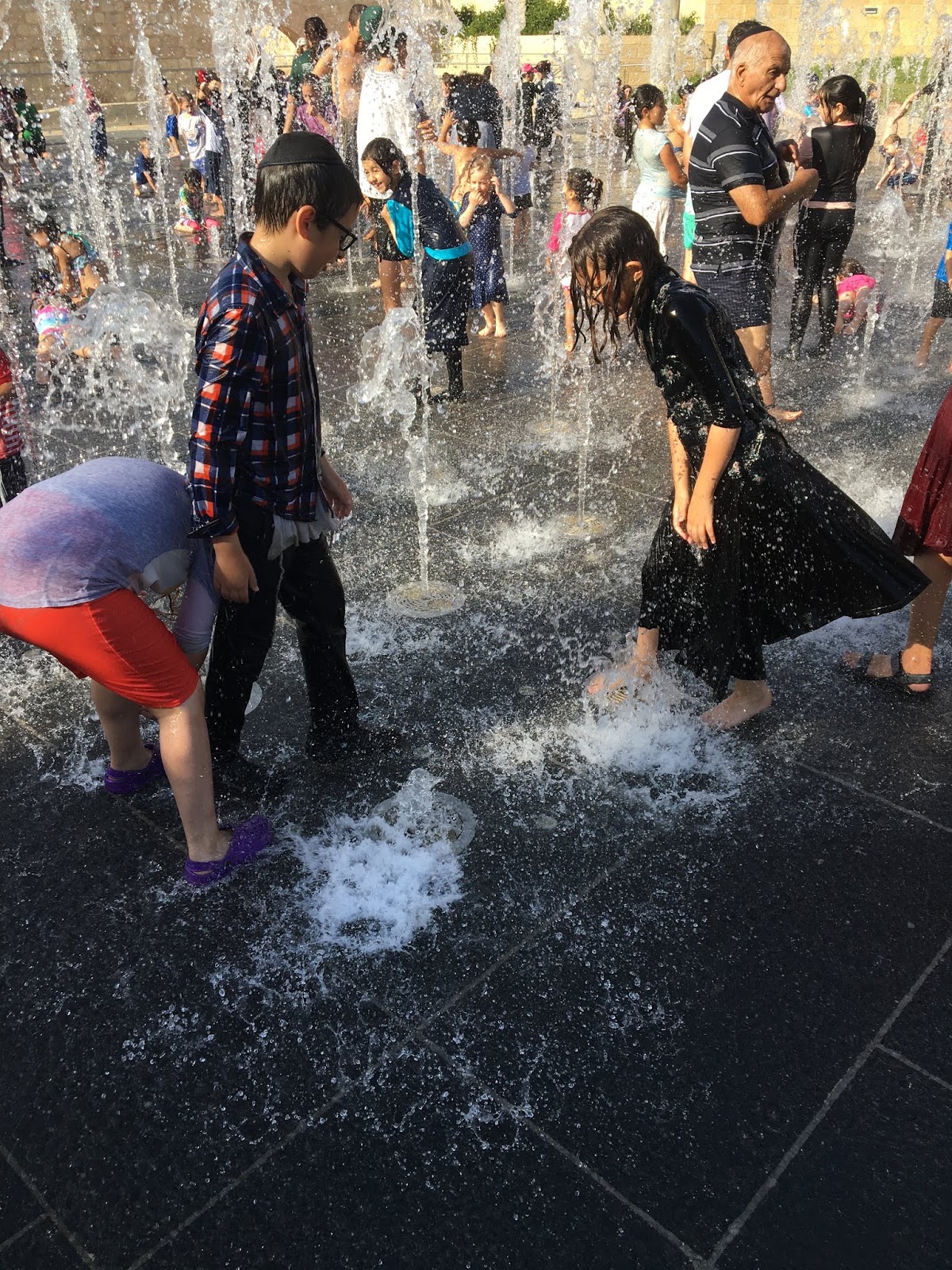
Tour book in hand, I decided that the Old Train Station sounded like a nice way to finish our “touristing” for the day. I was pretty certain, based on Waze GPS, that it was a fairly direct path of walking to there, through Teddy Park. I was wrong. We were hot. We were tired. And we were accidentally right next to an awesome water park. We couldn’t figure out why a crowd of people with kids in swimsuits were gathering around. Finally we were told that starting in five minutes the floor would come alive with spouts of water. The water literally danced from the floor. The kids went in fully dressed, and we didn’t care. Ok, Avi kinda hesitated about the fully dressed thing, and Asher was actually rather scared at first, but then the big kids “escorted” him.  It was the best accidental tourist incident ever!


The day had been full and exhausting (mostly due to the heat). We headed back to our van and returned to the apartment to finish packing and get ready for dinner. For our farewell to Jerusalem dinner we went to Café Rimon and then strolled around the Ben Yehuda Street area picking up a few last minute items.

Sunday morning we rose bright and early and headed back to Montreal (and my mom back to Harrisburg)


Hope you all enjoyed following our journey!

Friday, September 1, 2017

Teshuva and the Process of Humbling Oneself

“If My people, who are called by My name, humble themselves, pray, seek My face and turn from their wicked ways, then I will hear from heaven and will forgive their sin and heal them” (II Divrei Hayamim 7:14).

Most of us don’t get a chance to study Divrei Hayamim, and I only stumbled upon this quote when searching for new material for JewishTreats.org (my day job, so to speak). I never managed to find a way to use it in a Treat, but it stayed in my mind until I was ready to write my Elul group DT.
This quote is from the seventh perek of II Divrei Hayamim, which discusses the completion of the building of Solomon’s Temple. Hashem told Solomon that the people would stray and He would cause famine and pestilence against them. Verse 14 is the path to redemption, meant to take place in the Temple,  laid out by Hashem. Like so many verses in Tanaach, this posuk has meaning and significance beyond the context in which it is written. It offers the steps for the nation to redeem itself, and a beautiful path for individuals as well.

Quite often discussions at this time of year focus on the actions of teshuva: recognizing our transgressions, regretting them, confessing them, apologizing for them and actively seeking not to repeat them. I wonder, however, if this posuk in Divrei Hayamim is revealing that the action of teshuva, which is “turn from their wicked ways,” is actually the last step in a much more complex process.

Perhaps the teshuva process really begins with humbling one’s self. While one could say that is what is accomplished in recognizing one’s transgressions, I think that the process of humbling one’s self is more than just saying “I sinned.” Rather, it is recognizing our humanity, our inability to achieve perfection, and, therefore, our total dependence on Hashem.

The process of human humbling often, but not always, is a reaction to something happening to us: a business deal going awry, an injury, or, perhaps, drastic weather. This is when we turn to prayers from the heart that lead us to contemplate God and the world. Prayer is particularly on our minds during Elul and Tishrei. Even our prayers that we say everyday, without the incitement of being humbled, are transformed during the Aserres Y’mei Teshuva, when we have to slow down and remember the subtle changes in wording.

Prayer is our venue in which we speak to Hashem, but the truth is that many of us pray out of a sense of yira - reverential fear - the reaction to knowing how much greater Hashem is than we are, how much we have for which to be grateful to Him (an understanding that comes through humbling one’s self). In the pasuk from Divrei Hayamim, the final step that comes before the actions of teshuva is “seek my face.” This step is striving to act out of ahava - love - rather than yira.  To seek God’s face it to try to get closer to Him, an act of a loving relationship.

Once these steps have been achieve, only than can true, heartfelt teshuva happen because it is not then an act, it is not a hope, it is not a striving. When we can achieve ahavas Hashem, then our act of teshuva is transformational. And this idea leads me to another quote I found that same day which I tried to use as well (but didn’t):

“Rabbi Meir used to say, ‘Great is repentance for on account of one true penitent, the entire world is pardoned” (Talmud Yoma 86b).

I do try and do proper teshuva during Elul and Tishrei, and I can’t say I do a fabulous job because I honestly can’t remember the majority of transgressions that I am certain I have committed. So when I read this quote, I was trying to imagine the power of such a true penitent and I think that such a penitent would have to be one who had really and truly transformed their emunah and their relationship with Hashem.

For those of us who are still just working on humbling ourselves, on embracing emunah and, perhaps, learning to pray truly...Rabbi Meir’s statement can also be read differently. When an individual works hard at the actions of teshuva, just the final steps of turning from wicked ways, and succeeds, they have, indeed, managed to ensure that an entire world is pardoned: their world. As it says in Sanhedrin 37a: “Whosoever preserves a single soul..., scripture ascribes [merit] to him as though he had preserved a complete world.”

As much as we would love to be superheros (ok, I’d just like to get through a day without screaming at my kids), the fact is that our first and most necessary project is to work on ourselves. We as a nation have to power to change the world, and we, as individuals have the power to be world-changers by effecting, ourselves and the world around us.

The women in this group are definitely world-changers. I’ve been part of the Elul group since its beginning, and I have seen the beautiful growth of the women involved, some friends, some strangers, but all dear to me at this time of year. Without question, Caryn and Ruthie deserve special credit in that world changing department, because they have offered this opportunity and encouraged me even in the years that I thought I could not actually manage it. May we all continue to grow together in emunah, yiras Hashem and ahavas Hashem.

Sarah Rochel Hewitt
----
So, one of my earlier drafts began like this, and I just wanted to include it as well as a separate thought:

“Rabbi Meir used to say, ‘Great is repentance for on account of one true penitent, the entire world is pardoned” (Talmud Yoma 86b).

I feel like I should apologize right here and right now. Sorry guys, I don’t think I am gonna make the cut this year. Sheesh, I don’t think I’ve ever come close to making that cut. And for that, I am sorry. Well, perhaps sorry is the wrong term...And for that I have regret and, to be perfectly honest, a good bit of guilt. I am so far from where I need to be that I wonder, sometimes, if there is something wrong with me.

But questioning, seeking, searching, accepting and starting all over again seems to be a critical element in Jewish life. It’s not for no reason that we ask for tshuvot (responses) as we learn how to grow spiritually and work toward true teshuva.

This past summer, my almost Bat Mitzvah daughter gave me a joltingly beautiful understanding of this process of growing through asking questions. On Shavuot, she informed me that she and several of her friends had been talking about “stuff” and, basically, questioning how one could actually know if any of what they were being taught was true. I was alarmed, mildly, yet pleased, mildly, too, because I know this is a critical step in her owning her Judaism for herself. I suggested we start learning something together and we went off looking for the right book to learn. We spent a month looking for something that was neither pre-supposing of emunah (like Living Emunah, which tells you how to live a life of emunah, but not how to gain emunah) or to baal teshuva oriented or too mature for her. Then life got busy and our search was forgotten a bit.

When, later, asked her if she was upset that we hadn’t managed to follow through on this project and find a sefer, she said no because she had come to realize that the answer was too big for someone to answer in a book and that these questions were actually too big for herself to be able to simply judge and understand.

I was blown away by her response. If only my own battle for emunah could be so brilliantly resolved!

Thursday, December 29, 2016

The Drippings of My Menorah

Do you clean your menorah each night after the flames have finished burning? Goodness knows I don’t, and each night it gets a little trickier to light the menorah. There’s old wax stuck in the hole, even after you use a random household item to try and scrape it out, and the cheap Chanukah candles break when you push them in. Or if you’re using oil (in our house we have both), then the cups from the first few nights are always grimy and slippery from previous splashes. So in our house, where we light quite a few menorahs, by the time we get to the eighth night of Chanukah, we have a pile of broken candles that never made it, lumps of broken off wax drippings (many imprinted with fingerprints) and a few discarded, slimy wicks from the oil menorah. And if you have one of those candle menorahs where the shamash, the lighting candle, is elevated in the middle of the row, every time you try to place the shamash in its proper spot, you bump into the candle next to it, resulting in additional spillage!


The mess of the Chanukah candles may seem  like a silly issue to discuss, but just the other day I was thinking that this issue may serve as an interesting metaphor for Jewish growth. When a person first becomes excited about Judaism, it is like setting up the menorah. There is great anticipation about participating in the new mitzvot, and the first acts of Jewish observance that one does on one’s own can be  compared to the first night of Chanukah. The menorah is in pristine condition and the candles fit in easily (unless, of course, it wasn’t cleaned after last year).

Time passes, however, and for many people who have moved toward greater Jewish observance, living a more involved Jewish life often results in the loss of some of the original sparkle of being new. It gets harder. Unexpected obstacles arise: bosses who have “emergencies” just before Shabbat or relatives who don’t understand the implication of “kosher style.”

More challenging than the unexpected obstacles, however, are the slimy drippings of apathy and routine. Mitzvot that were once exciting start to feel like common acts. There is a constant struggle to grasp again the beautiful inspiration that so energized those original first steps.

The Talmud records a disagreement between two of the great academies of Talmudic study: the Academy of Shammai and the Academy of Hillel. The first believed that eight lights should be lit on the first night of Chanukah, and one less on each night that follows. Hillel’s students, on the other hand, said that on the first night one candle is lit, adding one each night until eight candles are lit on the last night (Talmud Shabbat 21b).

One explanation cited in the Talmud for their different opinions was that the Academy of Shammai was comparing the candles to the decreasing number of bulls brought on the holiday of Sukkot. The Academy of Hillel, on the other hand, was underscoring the idea that matters of sanctity should always be increased rather than decreased” (ibid.).

It was decided that the practice of Chanukah should be observed according to the opinion of the Academy of Hillel. Each night we increase the light until the eighth glorious night when all eight candles burn in its full glory.

Following the path of traditional Jewish life can have its challenges. But the greater the effort that we invest, the brighter the light that we shine. The mitzvah of Chanukah is intended to proclaim to the world our faith in God’s constant and active role in our lives. This is what we do when we tell that boss that we cannot work late on Friday or explain that the term kosher of “kosher rye” refers to a style and not that the bread is actually kosher.

Jewish life is a spiral of cycles. There are the daily cycles of prayer, the weekly cycles of Shabbat, and the yearly cycle of holidays. Each requires preparation. If I, as a working mother of five, don’t pick away at the “wax drippings” of chaos that dominate my home every morning, then I won’t have time for the daily morning prayers. If I don’t prevent “slippery spots” from entering my schedule, then I have to work harder to prepare for Shabbat, and if I don’t prepare in advance, then I cannot make the most of the beauty that inhabits each of the Jewish holidays.

If I were to continue my metaphor of the crowded menorah, then perhaps I would say that not only do I shine brighter the more effort I invest, but I would also connect to the shamash.  For everything that I do, my role is now that of being a continual helper. How I treat my own menorah -- my own spiritual development -- is reflected in the lights that surround me, the neshamot (souls) of my children.

This year, as the lights of Chanukah increase and we each stand by our menorahs trying to remove the drippings from the night before, think not of the struggle against the wax, but rather of the incredible brilliance and rays of  holiness of your beautiful Jewish soul.

Wednesday, September 14, 2016

Facing Manhood

This Dvar Torah was written as part of a group that says Tehillim/Psalms together during the month of Elul (through Yom Kippur).


5777 - This is the year my son will “become a man,” as popular Bar Mitzvah messages assert. In just over seven months, my bachor will become Bar Mitzvah and for the last several months this fact has become a constant little niggle, that type of thing one says one isn’t going to think about but nevertheless finds oneself constantly discussing. Halls for the kiddush, caterers, how to balance the different things he needs...

As I sat thinking about the Dvar Torah I wanted to write, the Bar Mitzvah once again popped into my head. This time, however, my thoughts were not focused on the “to do” but rather on the personal significance. Every year when I get “the call” (ok, the email, but it’s so much more dramatic sounding the other way) about the Elul group, I become suddenly more aware of the growth I need to do, of the growing I haven’t done... of my status as a baneinu. I’m not bad, but I’m not particularly good, either.

Twenty some odd years ago, I started keeping mitzvot. The first several years were all about acquiring knowledge and adding observance. They were hard because had to bend myself, but they were easy because there was so much new to do...and so much encouragement!

When I got married, I expected many things from myself, but life, work, children, running...running...running (B.H.) kept me very busy. Slowly, learning and growing drifted away. Even davening. Last year, I believe, I wrote about davening and how much I increased my davening as I expected my fifth child. One of the other reasons I made an active effort to increase my davening was that I wanted my children, my girls in particular, to see me daven, to know that it wasn’t just Tatty who did so.

This year, about two months ago, I found a whatsapp group of women in my neighborhood (mostly). The group is about emunah and growth but, to be honest, I really joined it to try and build a stronger social connection within Montreal. I found much more. I am in awe of the spiritual drive of these ladies, just as I am in awe of the dedication of the ladies of this Elul list -particularly, of course, Caryn and Ruthie, who have been doing this longer than a bar mizvah.  Last week this group spoke of the idea that a tzadik cannot stand in the same place as a Baal Teshuva, which led to a discussion of how doing teshuva provides each person witha chance to not only start anew, but to really start to be new. As the conversation got deeper, I was struck by the thought that I didn’t really deserve the title of Baal Teshuva anymore. Sure, became observant on my own, but last year I actually passed the mark of being shomer Shabbat longer than not being shomer Shabbat...and what growth had I been doing?

Today (ok, tomorrow) is first day of Elul. The King is in the Field! Now is the time, the best time, for me to seize the day and start myself anew. This Elul, I want to use the energy of the month to call out from my heart: “Hashem, help me grow! Hashem, open my soul! Hashem, help me feel that passion I felt when I first started this journey. And Hashem, help me show that love and passion for Torah to my children!”

The ladies with whom I have been learning are incredible, spiritual and connected on an emotional level. If you know me, you know that is not so much how I am wired. But I learn from them, as I learn from each woman on the Elul list each year, how to be a little more. And from each of these things I am inspired by the necessity to open up, to call out and communicate to Hashem in the same way I have a “heart to heart” with a good friend, and then more so.

Once upon a time, I used to seek out deep texts and challenge myself to create innovative and admirable divrei Torah. I wanted to do that again...So here is a very brief thought, and not that wow. I have been looking into Mishlei a bit, an excellent source of quotes on which to build Jewish Treats, and I was struck by several verses in Chapter 16:

16:3 Commit your works to the Lord, and your thoughts shall be established.
16:7 When a man's ways please the LORD, he makes even his enemies to be at peace with him.
16:9 A man's heart devises his way: but the Lord directs his steps.

If I have the right intention in any of my endeavors – I try to exercise knowing that I am acting on a mitzvah of taking care of my body, if I focus on cooking Shabbas not as a chore (yes, sorry, week after week) but for the mitzvah - then God will help me in those actions. And I believe this means, for me at least, that I will gain a level of serenity from doing them. This connects to the next verse quoted, but my biggest enemies are in my head. From the yetzer harah to low self esteem, I am easily brought into a negative headspace. When I have given my thoughts and actions a God-focused perspective, however, I find more peace. Last, but not least, of course is a verse that makes me think of “man plans, God laughs,” but it is not nearly so flippant. This is the essence of free will. I get to make decisions, but God is still maneuvering all the pieces on the board to either help or hinder my wishes from coming true.

I don’t know if that made sense to anyone, and in truth I am adding that paragraph just before sending it (when I should be cooking). Mostly now, I write to inspire only myself, and, if by chance you can relate to what I have set down, I hope I give you chizuk as well. I often find that reading of other people with similar thoughts, feelings, experiences can give me strength to grow and move forward.
In seven plus months, my son will have to take responsibility for his own mitzvot. During the hectic months to come, I hope to work on myself as well, so that when he becomes something more, I too can be something more and reclaim the legitimacy of the label B.T.

Thank you all for the inspiration.